Governments

Digital Sovereignty
and Growth

myGaru empowers digital transformation towards a sovereign ecosystem by localising data, advertising and AI services within national borders.

Advantages

Protected citizen personal data

Localisation of advertising & data markets

Data environment to fuel innovations

Data-driven efficient governance

Sovereign AI assistants infrastructure

Trust Framework

uniting local businesses for shared growth
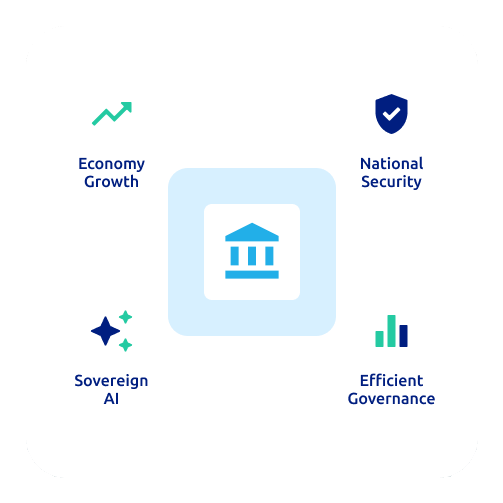
Economy Growth

A national data infrastructure that localises the ads & data markets and drives greater efficiency across the economy.

Challenge

Digital advertising accounts for 0.5–1.6% of national GDP, yet the majority of this revenue is extracted by a handful of Big Tech platforms with dominant market power.

Solution

By using telecom networks as the basis for a national advertising ID, myGaru anchors digital advertising inside the national economy, redirecting value creation to domestic businesses.

Challenge

“Data access and sharing is estimated to generate social and economic benefits worth between 0.1% and 1.5% of gross domestic product (GDP) in the case of public-sector data, and between 1% and 2.5% of GDP (in a few studies up to ~4% of GDP) when also including private-sector data.”

— OECD

Solution

As an independent data intermediary, myGaru provides a federated national data infrastructure where telecom, retail and other domestic datasets interoperate with transparent vendor-level compensation for each authorised use.

Challenge

The absence of a unified identity standard has created deep silos between national data vendors. Although ID is essential for utilising data, incompatible identifiers prevent sectors from working together and block the development of a truly national data economy.

Solution

myGaru unifies fragmented national datasets by using telecom-verified identity signals to resolve silos and enable secure, cross-sector data collaboration within a single trust framework.

Challenge

The use of static identifiers such as emails or phone numbers exposes businesses to uncontrolled downstream data reuse, creating unacceptable risks that deter them from participating in data collaborations.

Solution

myGaru uses session-based identity embedded into national internet service provider networks, with per-use decryption and a cryptographic audit trail that makes data interactions transparent, verifiable and accountable.

Challenge

The high cost and operational burden of developing first-party data capacity reinforce structural inequality, enabling large firms to dominate data value chains while SMEs are locked out of innovation and dependent on overpriced Big Tech monopolies.

Solution

myGaru gives SMEs access to national first-party data tools through existing B2B vendor workflows, combining low-barrier entry with fast distribution to smaller businesses and helping them compete in the data era with less dependence on Big Tech monopolies.

Challenge

Complex privacy requirements and bespoke legal agreements for each data partnership create structural barriers that deter companies from collaborating, even when doing so would generate clear economic and operational value.

Solution

myGaru provides a unified compliance and integration framework: once a business completes a single onboarding, it can collaborate securely with all connected data partners without repeated bilateral legal processes.

01/06

National Security

A telecom-grade identity that eliminates high-risk identifiers and strengthens the security of the national digital space.

Challenge

Cross-border data transfers are increasingly restricted worldwide, yet enforcement remains constrained by a structural dependency: domestic businesses rely on foreign Big Tech platforms to understand and reach customers, while media owners rely on them to monetise audiences.

Solution

myGaru provides locally governed data infrastructure that enables local data activation across Facebook, Instagram, TikTok and YouTube without cross-border data movement, helping governments enforce data localisation restrictions without disrupting business workflows.

Challenge

The ad market relies on static identifiers (emails, cookies, device IDs, phone numbers) that, by design, prevent control over downstream data reuse, exposing national data flows to unchecked foreign exploitation.

Solution

myGaru links telecom infrastructure with the adtech ecosystem to establish a nation-wide, session-based identity standard that enforces controlled data use and introduces decentralised identity, giving each citizen multiple securely authorised IDs per business.

Challenge

Existing cookie consent pop-up mechanisms allow foreign companies and intelligence services to harvest citizens’ data without meaningful limits, exposing the nation to espionage and influence operations.

Solution

A national telecom-verified identity layer, connected via myGaru to the adtech ecosystem, provides the foundation for a sovereign consent framework that stops uncontrolled data flows to foreign actors.

Challenge

National media are steadily losing popularity to foreign platforms, which enjoy structural advantages in personalisation, audience understanding and monetisation capacity, limiting local publishers’ ability to retain users and fund higher-quality services.

Solution

myGaru links telecom and other national data sources directly to domestic media, enabling publishers to better understand and retain their audiences while creating the conditions for higher advertising revenues per visitor.

Challenge

“Phone numbers and email accounts are core enablers for identity fraud, account takeovers and social engineering attacks.”

— Europol

Solution

By introducing a nationwide telecom-verified identity natively integrated into a federated data infrastructure, myGaru creates a superior mechanism for preventing fraud and online scams across the national digital environment.

01/06

Efficient Governance

A unified national data framework enables evidence-based decisions, real-time oversight and high-precision public communication.

Challenge

“51% of public-sector organisations cite lack of a data and digital transformation strategy as a barrier; 45% say their data infrastructure is inadequate; and 62% claim privacy and security concerns limit their ability to adopt advanced data analytics.”

— EY

Solution

myGaru unlocks real-time behavioural and economic intelligence for governments, enabling data-driven policymaking while removing the integration, cost and compliance burdens typically associated with multi-party data collaboration.

Challenge

“Children and adolescents are still regularly exposed to the digital marketing of many unhealthy products such as alcoholic drinks, HFSS foods, tobacco, and electronic nicotine-delivery systems.”

— WHO

Solution

Telecom-verified identity integrated into adtech enables effective governance of digital marketing, preventing exposure for children and other vulnerable groups while providing a transparent, easy-to-implement mechanism for all market participants.

Challenge

“Governments face unprecedented challenges in public communication as information ecosystems become more fragmented, digitalised and vulnerable to manipulation.”

— OECD

Solution

myGaru overcomes digital fragmentation, giving government a unified, telecom-driven mechanism for high-precision public communication.

01/06

Sovereign AI

A sovereign data foundation empowers the country to build safe, nationally governed AI and secure long-term digital competitiveness.
Challenge

“The EU’s ability to develop and deploy trustworthy AI depends on access to high-quality data. Excessive reliance on non-European platforms poses economic and security risks.”

— European Commission

Solution

myGaru creates a trusted, interoperable data environment that brings together telecom, retail and financial signals, ensuring nationwide access to high-quality data essential for national competitiveness in the AI era.

Challenge

“Data complexity and lack of readiness remain the top obstacles, with 79% of organisations saying they cannot fully leverage AI because their data is too siloed or not in the right format.”

— IBM

Solution

myGaru-enabled data backbone allows businesses to unify fragmented datasets into a coherent, AI-ready foundation — without the cost burdens of conventional enterprise solutions.

Challenge

“AI-driven recommendation and assistant systems risk reinforcing the gatekeeper power of large platforms, allowing them to steer consumer choice and restrict market contestability.”

— European Commission

Solution

myGaru enables telecom-verified AI assistants accessible across all local publishers, ensuring personalised, context-aware distribution within an open market model where no single platform controls access.

Challenge

“Governments are making significant investments in AI infrastructure, yet many lack clear use cases or coherent strategies for applying these capabilities in public services.”

— OECD

Solution

By preparing businesses with a unified data infrastructure for AI-enabled B2B services and powering national AI assistants across consumer channels, myGaru creates the conditions for scalable use cases that drive sustained demand for sovereign AI capacity.

01/06
European Commission
“Specialised data intermediaries that are independent from both data holders and data users can have a facilitating role in the emergence of new data-driven ecosystems independent from any player with a significant degree of market power.”
— European Commission

myGaru sets the highest standard of neutrality

01

No affiliation with telecom operators

If an identity solution were owned by a single telecom, others would not join and cross-operator scale would fail; neutrality is essential for a truly national framework.

02

No affiliation with media assets

Owning media assets while operating a monetisation framework creates conflicts seen in Big Tech; neutrality ensures fair value distribution and empowers all domestic publishers.

03

No affiliation with retailers or e-commerce

Retail or e-commerce control can deter competitors from joining a shared data network over concerns about access to customer data; neutrality enables wider adoption across retailers.

04

No affiliation with data-using services

Affiliation with data-using or data-generating services would incentivise favouring certain players; neutrality removes the risk of market capture through privileged data access.

05

No affiliation with corporate groups

Foreign international groups’ influence could steer national data towards external priorities and acquisitions; neutrality protects competition and prevents the displacement of local players.

06

No affiliation with AI providers

If tied to a single LLM provider, the national data framework would face structural bias and stifle innovation; neutrality keeps the field open and ensures access to top-performing models.

How to build thriving digital sovereignty?

Cases

Tapping Telecom Data for Audience Accuracy Beyond Google Analytics

Analytics solution, Nexinsight, revealed significant inaccuracies in Google Analytics’ gender split and enabled high-income audience segmentation for tailored offers, resulting in improved CTR for fashion e-commerce platform Kasta.

View Case
Cases

From Cookie-Based to Telecom ID–Driven Data Monetisation

Kyivstar transitioned data monetisation from a third-party cookie setup to a telecom-based identity infrastructure powered by myGaru, increasing addressable reach, enabling cross-channel activation and activating interoperability with other data vendors.

View Case

Frequently Asked Questions

How much does a government need to invest in infrastructure to launch myGaru?

myGaru requires no capital investment from the government. The platform runs on a federated model, where businesses deploy their own instance of myGaru software, while identity resolution operates via integrated with myGaru national telecom infrastructure.

Where is myGaru’s cloud infrastructure located?

myGaru cloud is hosted within each country where the platform operates. It is specifically designed to prevent any cross-border data transfers — even during cohort-based processing between collaborating businesses using myGaru’s cloud-side software.

What is myGaru’s business model?

myGaru’s model is based on success-based fees from transactions within the platform, with no upfront investment required. For example, businesses that monetise their data charged a commission from actual data earnings, while advertising services pay an identity resolution fee per use — transferred to telecoms after deduction of myGarup-relate technical commission.

Who is behind myGaru and how is operational transparency ensured?

myGaru has intentionally avoided investment from VCs and multinational corporations to remain fully independent and offer governments a neutral product designed to support an equidistant, diverse data ecosystem. For added transparency, each country includes a local public board made up of nationally trusted figures who provide ongoing oversight of platform operations.

How is AI safety ensured in myGaru’s citizen-facing AI assistant?

myGaru follows a decentralised operational model adapted to local cultural and regulatory contexts. In each market, the large language models (LLMs) used are selected by local stakeholders — including telecom operators and government bodies — to ensure trust, safety, and alignment with national interests.

Is myGaru compliant with GDPR and other national data protection laws?

Yes. myGaru was designed to comply with GDPR and can be flexibly adapted to meet the regulatory requirements of any country where it operates. The platform enforces strong privacy safeguards, prevents data enrichments between participants, and provides citizens with two-layered control over their data.

Hello. Привіт. Hola. Ciao. 你好

Join our network to start growing